
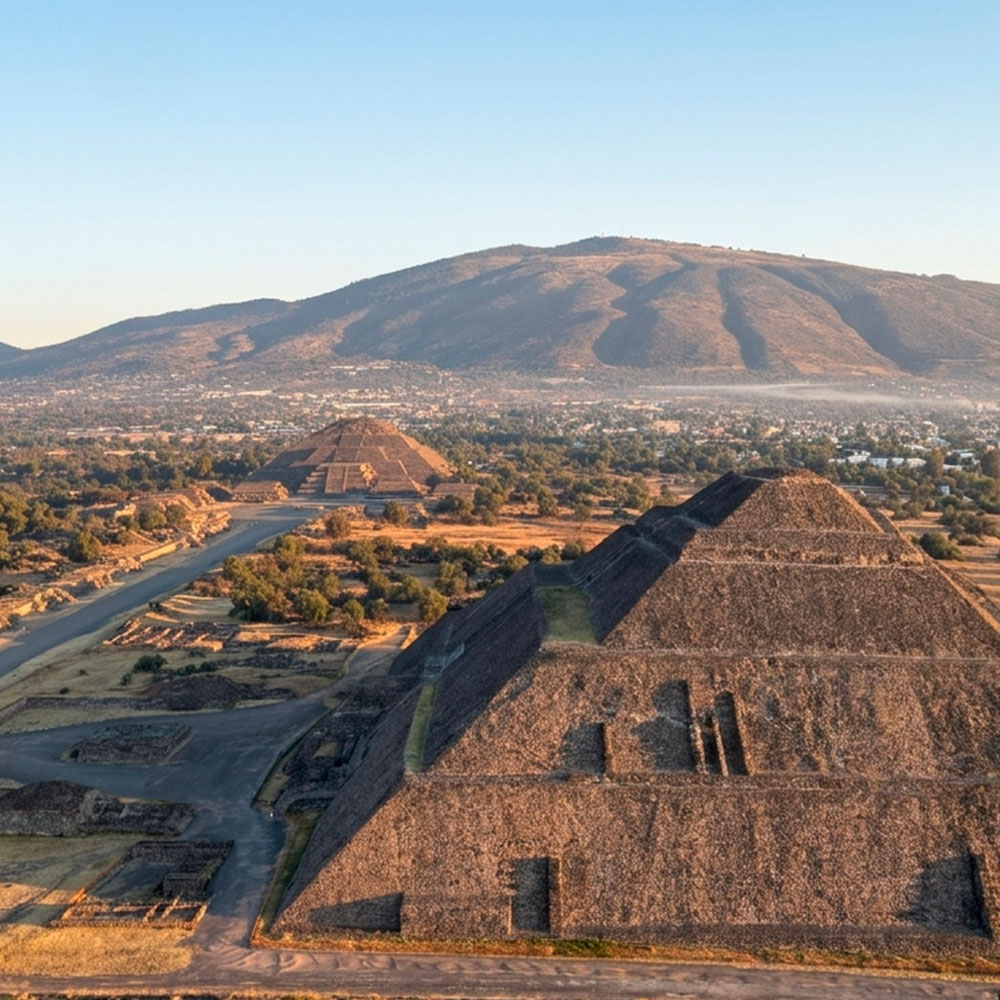
Search for a day trip from Mexico City and you will find, somewhere in the first page of results, a listing that offers you the Mayan pyramids of Teotihuacán.
They are not Mayan pyramids. The Maya heartland lies more than a thousand kilometres to the southeast, across mountains and into a different climate, a different language family, and a different political world. Selling Teotihuacán as Maya is roughly like advertising the Colosseum as a triumph of Greek engineering — near enough geographically that a visitor might not notice, wrong enough that anyone who knows the material stops reading.
The mistake is worth correcting for its own sake. But it is worth correcting mainly because the truth is considerably more interesting than the error. Teotihuacán was not built by the Maya, or by the Aztecs, and the question of who did build it is one of the great open problems in the archaeology of the Americas.
What the city actually was
At its height, in the first centuries of the common era, Teotihuacán covered some twenty-two square kilometres and held a population above a hundred thousand — placing it among the largest cities on earth at the time, in the same order of magnitude as imperial Rome.
It was planned. This is the detail that never survives a bus tour and should. The city was laid out on a deliberate grid, oriented off true north by about fifteen degrees, with a monumental axis — the avenue later visitors would call the Street of the Dead — running through its centre. Most of the population lived in walled apartment compounds, multi-family stone-and-plaster structures arranged around central courtyards. Whoever governed Teotihuacán was housing a hundred thousand people in standardised urban blocks while most of Europe was still building in wood.
It flourished for something like six centuries and was gone, as a functioning city, before the Maya classic period ended — and roughly seven hundred years before the Aztecs arrived in the Valley of Mexico. UNESCO inscribed it as a World Heritage site in 1987.
Nobody knows who built it
This is the sentence that surprises people, and it comes from Mexico’s own national institute rather than from any fringe theory. The founders’ ethnicity is unknown. The language they spoke is unknown. The name they called their city is unknown. Candidates have been proposed — Nahua, Totonac, Otomí populations among them — and none has carried the field.
The reason is stark: Teotihuacán left no readable writing. The city produced a rich symbolic system, and specialists continue to debate how much of it functions as script, but there is nothing at Teotihuacán equivalent to a Maya inscription — no dated texts, no named rulers, no dynastic records. Six centuries of one of the largest cities in the world, and not one person in it whose name we can pronounce.
No royal tomb has been securely identified either. For a Mesoamerican capital of this scale, that absence is itself evidence, and it has driven a long-running argument that Teotihuacán may have been governed by something other than a single hereditary king — a council, or competing lineages, sharing power in a way that left no portrait sculpture behind. Compare that with the Maya cities of the same era, whose rulers put their faces, their names, their accession dates and their military campaigns on carved stone in public plazas, and the contrast stops being a technicality. These were two profoundly different kinds of society.
Even the name is borrowed
“Teotihuacán” is a Nahuatl word, and Nahuatl was the language of the Mexica — the people we usually call the Aztecs — who arrived in the valley some six centuries after the city had been abandoned.
They found the ruins and were awed by them. INAH renders the name they gave the place as “where the gods were created,” and the exact translation is still debated among linguists. What is not debated is what the Mexica believed had happened there. In their cosmology, the current age of the world — the Fifth Sun — began at Teotihuacán, when the gods gathered in darkness and one of them threw himself into a fire to become the sun. That story is carved into the most famous object in the National Museum of Anthropology.
When the Spanish asked the Mexica who had built the city, the answer was that they did not know. Some said giants. The Aztecs were pilgrims at Teotihuacán, not its architects — visitors to a ruin, like you.
Where the Maya actually were
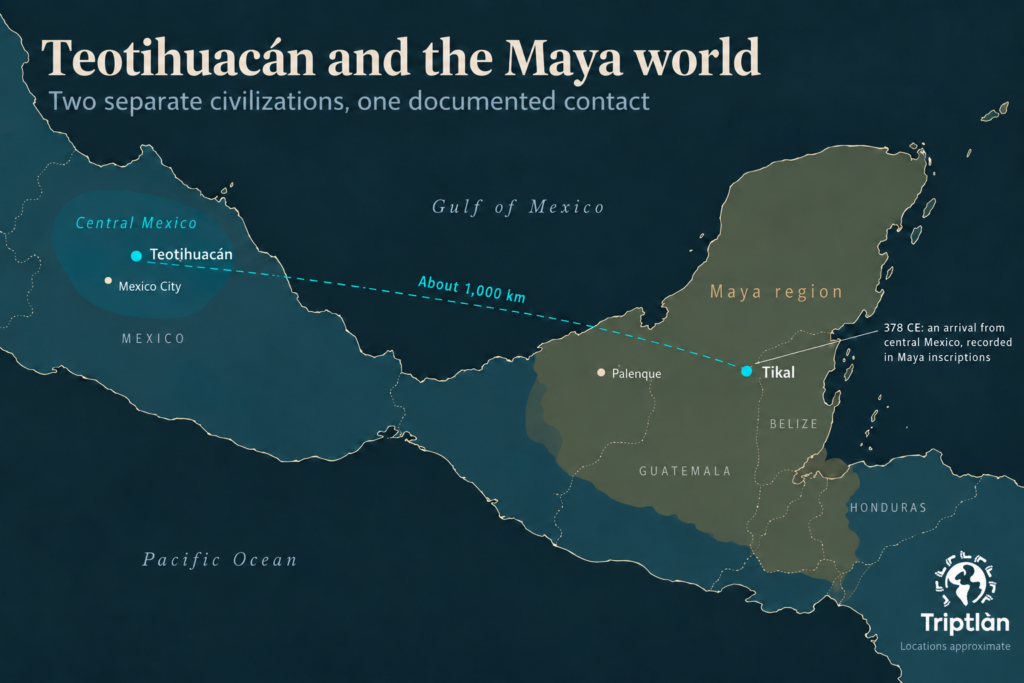
The Maya world occupied the Yucatán peninsula, Chiapas, Guatemala, Belize and western Honduras: lowland tropical forest and highland valleys, a thousand-plus kilometres from the central Mexican plateau. Its cities — Palenque, Tikal, Copán, Calakmul, Toniná — were independent kingdoms that allied, traded and fought with one another across centuries.
And they wrote. Maya script is logosyllabic, combining signs for words with signs for syllables, and it is the only writing system of the pre-Columbian Americas that has been shown to record a spoken language in full. Which means Maya monuments are documents. Stand in front of a Maya stela with someone who can read it and you get a date, a name, an event — history in the ordinary sense of the word. Our Maya epigraphy tour exists because of exactly this.
Two civilisations, then, separated by distance, language and time, and distinguishable at a glance once you know what to look for. Teotihuacán built in talud-tablero, a sloping wall surmounted by a framed rectangular panel, repeated up a façade. The Maya built corbel-vaulted chambers and covered their buildings in carved text. One is anonymous and geometric. The other signs its work.
The part that makes this genuinely interesting
Having separated the two civilisations, we now have to put them back in contact — because they were, and that is where the real story lives.
On a day in January of the year 378 CE, a man the inscriptions call Sihyaj K’ahk’ — “Born of Fire” — arrived at Tikal, one of the great Maya capitals. The Maya recorded the date, because the Maya recorded dates. On the same day, Tikal’s reigning king died. A new ruler was installed shortly afterward, a figure whose parentage points back toward Teotihuacán, and the city’s art and politics shifted.
Epigraphers have been working on this episode for decades, and its outlines are now widely accepted: an intrusion from central Mexico, remembered in Maya texts, that reshaped the dynastic history of the region. Who exactly Sihyaj K’ahk’ answered to remains a live question — a figure known as Spearthrower Owl appears in the same texts, and the proposal that he was a ruler of Teotihuacán itself is an influential hypothesis rather than a settled fact. Archaeologists have since identified a walled compound at Tikal built in Teotihuacán’s architectural idiom, evidence of something more sustained than a raid.
And the traffic ran both ways. Excavations in Teotihuacán’s Plaza of the Columns complex have recovered more than a thousand fragments of mural painting in unmistakably Maya style — almost certainly the work of Maya artists living in the city. The same deposits produced Maya ceramics and evidence of a feast held around the middle of the fourth century. One of the more remarkable finds was the skeleton of a spider monkey, an animal from the Maya lowlands, held in captivity at Teotihuacán and buried in what researchers read as a diplomatic offering. A gift, in other words, sent between two powers that knew perfectly well they were different from one another.
Teotihuacán also housed permanent foreign neighbourhoods — a district of people from Oaxaca who buried their dead in the manner of Monte Albán and kept it up for generations, and a merchants’ quarter full of Gulf Coast material. This was a cosmopolitan capital with resident foreign communities, in contact with the Maya world by trade, migration and at least one episode of armed politics.
So the honest correction is not a flat denial. It is this: Teotihuacán was not a Maya city, and the Maya were unquestionably present in it. The flat error obliterates a story far better than itself.
Why the mistake persists
Three reasons, none of them good.
“Mayan” has become a generic English adjective for anything ancient and Mesoamerican, the way “Viking” absorbs most of early medieval Scandinavia. Pyramids read as interchangeable to an eye that has not been trained to see the difference between a sloping panelled façade and a corbel vault. And listings on the large booking platforms are frequently written by people who have never been to the site, copying from listings written by other people who have never been to the site. The error propagates because nobody in the chain is in a position to catch it.
Which is the whole argument for who stands beside you at a ruin. A guide with research credentials is not a luxury flourish; it is the difference between being told something true and being told something that has been copied four times.
How it ended
Around the middle of the sixth century, the ceremonial core of Teotihuacán burned. The destruction was concentrated on the monumental buildings along the central avenue rather than spread across the residential city, which has persuaded many researchers that this was deliberate and internal — an uprising, or a collapse of the governing order — rather than a foreign conquest. Drought and the strain of feeding a hundred thousand people are part of most explanations. The precise sequence remains debated, and anyone who states it as settled is overreaching.
The city emptied. Centuries later the Mexica walked into the ruins, decided the gods had made the world there, and named the place.
Seeing it properly
There is a case for visiting the museum before the site. The Teotihuacán hall at the National Museum of Anthropology holds what the ruins cannot show you: mural painting with its colour intact, sculpture reassembled at eye level, the portable evidence of ordinary life in those apartment compounds. Walk the site afterward and you are filling in a city you have already begun to understand, rather than climbing an anonymous pyramid in the sun.
A detail worth noticing when you do: there is a Maya monument standing in the museum’s Teotihuacán hall, placed there by curators who know precisely what the relationship between these two worlds was. The museum’s own floor plan makes the argument this article has been making.
See our private Teotihuacán tours, or begin at the museum with a historian. Both booked directly with us, and both led by people who will tell you what is known, what is argued, and which is which.
Frequently asked questions
Is Teotihuacán a Mayan site?
No. Teotihuacán is in central Mexico, more than a thousand kilometres from the Maya region, and it flourished centuries before the Maya classic period ended. The two civilisations were in contact, but Teotihuacán was not Maya.
Who built Teotihuacán?
Unknown. The founders’ ethnicity, language and the city’s original name have not been established. Because Teotihuacán left no readable writing, there are no names or dynastic records to work from.
Was Teotihuacán built by the Aztecs?
No. The Mexica arrived in the Valley of Mexico roughly seven centuries after the city was abandoned. They named it, revered it, and made it the setting of their creation myth, but they did not build it.
Did the Maya and Teotihuacán ever meet?
Yes. Maya inscriptions record an arrival from central Mexico at Tikal in 378 CE that reshaped that city’s dynasty, and excavations at Teotihuacán have found Maya-style murals, Maya ceramics and evidence of resident Maya elites.
How do you tell Teotihuacán and Maya architecture apart?
Teotihuacán is built in talud-tablero — a sloping wall topped by a framed rectangular panel. Maya architecture favours corbel vaults and carries carved hieroglyphic text. One is anonymous; the other signs its work.
