
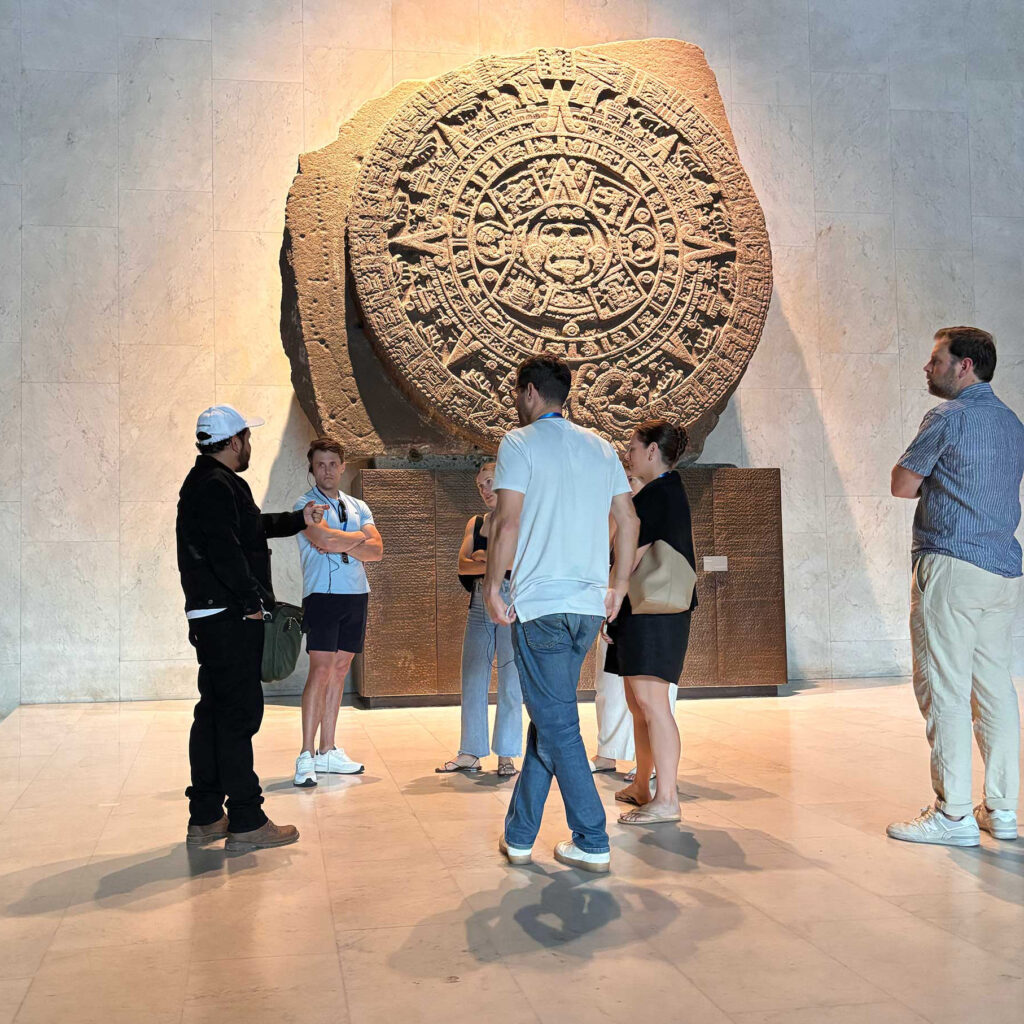
Stand in the Mexica hall of the National Museum of Anthropology and you are facing the most reproduced pre-Hispanic image in the world. It is on coins, on jerseys, on a million souvenirs, and on a great many tattoos. It is also one of the most consistently misdescribed objects on earth.
Visitors arrive calling it the Mayan calendar. It is neither. The Piedra del Sol is Mexica — carved in Tenochtitlan, the capital that stood where downtown Mexico City stands now — and it was never a device for keeping dates. What it actually is turns out to be considerably more interesting: a twenty-four-tonne statement about time, sacrifice and the end of the world, whose central face scholars are still arguing about after two and a quarter centuries.
Here is how to read it, including the parts nobody can read with certainty yet.
First, the two corrections
It is not Maya. The Maya were a lowland civilisation far to the southeast, with their own script and their own famous calendar — the one the 2012 phenomenon glued to this image in the popular imagination. The Sun Stone belongs to the Mexica of central Mexico: a different people, a different language, a different tradition, carved within roughly the half-century before the Spanish invasion. If the difference between those two worlds interests you, we have written the full correction.
It is not a calendar. The confusion is at least understandable: one of the stone’s rings does carry twenty day-signs from the Mexica calendrical system. But a ring of day-names no more makes this a calendar than a clock face carved on a tombstone makes the tombstone a clock. There is no mechanism here — nothing that tracks, computes or advances. INAH’s own researchers describe the monolith as a commemorative, iconographic work: an image of time as the Mexica understood it, not an instrument for measuring it.
The nickname is an eighteenth-century inheritance. After the stone was rediscovered in 1790, the scholar Antonio de León y Gama published the first study of it in 1792, and the phrase “Aztec Calendar” has been attached to the object ever since — a piece of early Enlightenment branding that outlived its own evidence by two hundred and thirty years.
What the carving says, ring by ring
The clearest published map of the relief is the museum’s own, written by the archaeologist Leonardo López Luján (2011) for INAH’s catalog of the collection’s hundred key works. The diagram below follows it. Select any part of the stone, or step through from the center, then read on for what each part means and where the arguments lie.
At the centre: a face with a knife for a tongue. The innermost circle holds a frontal face whose tongue is a sacrificial flint blade, flanked by clawed hands gripping human hearts. The traditional identification — argued by León y Gama, Chavero, Seler, Beyer and Alfonso Caso, and still the museum's presentation — is Tonatiuh, the sun itself, demanding the nourishment that keeps it moving.
But since 1974, when Navarrete and Heyden pointed out how closely the face resembles the earth lord Tlaltecuhtli, a serious counter-tradition has read the centre instead as an earth deity, or as the night sun at the moment of its nightly death in the earth's jaws. Klein, Townsend and Pasztory have all argued versions of this. Two and a quarter centuries after the stone came out of the ground, the identity of its central face remains an open scholarly question — and you deserve to know that, because the argument is a better souvenir than a false certainty.
Around the face: the date that names our era. The central face sits inside a large X-shaped glyph, Nahui Ollin — 4 Movement — the calendrical name of the age the Mexica believed they were living in: the Fifth Sun. In the four arms of the sign sit the name-dates of the four previous suns, four earlier creations each destroyed in its turn: 4 Jaguar, 4 Wind, 4 Rain, 4 Water.
The prophecy encoded in the era's own name was precise. The Fifth Sun would end in earthquakes — in movement. The stone carries the world's expiration notice at its heart.
And here the museum's rooms begin to talk to one another. In Mexica belief, the Fifth Sun was born at Teotihuacán, where the gods gathered in darkness and two of them gave themselves to a fire. Nanahuatzin threw himself in and became the Sun, Tonatiuh; Tecuciztécatl followed and became the Moon. From those two sacrifices came both lights, which then began their journey across the sky. The most famous object in the Mexica hall points, mythologically, straight at the ruined city an hour to the north — the city the Aztecs revered but did not build.
The ring of twenty day-signs. Next comes the band that caused all the trouble: twenty named days, beginning with Crocodile, then Wind, House, Lizard, Serpent, running around the stone like a frame of time itself. The evidence does not let us tie this ring to one particular calendar. What it does show is the measurement of time, built on twenty, the base of Mesoamerican counting and of its calendars. One possible interpretation links the ring to the Mexica idea of time and the creation of the Fifth Sun. The first sign, Cipactli, is a primordial creature resembling a crocodile. In the creation story, Tezcatlipoca and Quetzalcoatl take part in its transformation and death, and its body is used to form different parts of the world. Its place at the head of the ring may be related to that story of creation and the ordering of the earth. Either way, the ring represents time and honours it as sacred substance. It is not a count in working form.
The solar rays and precious signs. The outer field makes the sun explicit: large ray-points alternating with signs López Luján (2011) reads as jade beads, year symbols, feathers and precious water — the vocabulary of what is most valuable, wrapped around the image of the age.
The perimeter: two fire serpents. Bounding everything, two xiuhcoatl — fire serpents — descend the circumference from the top and meet jaw to jaw at the bottom, with faces emerging from their open mouths. Those faces are debated too; Tonatiuh and the fire god Xiuhtecuhtli are the usual candidates. Between the serpents' tails at the top sits a carved date: 13 Acatl, 13 Reed.
When was it carved, and for whom?
That 13 Reed date is where the dating argument lives. The traditional reading correlates it with the year 1479, in the reign of the ruler Axayácatl, and that remains the account you will hear most often.
A substantial body of modern scholarship, however, identifies near the top of the stone the name glyph of Moctezuma II — which would place the carving in his reign, between 1502 and 1520, with 13 Reed read not as the carving date but as the mythic year of the Fifth Sun's birth. What our historians will tell you plainly is that the stone is late Mexica, imperial, and bound up with the ideology of the ruling house. Which ruler commissioned it is a live question, and the arguments on both sides are part of what makes the object worth standing in front of.
What was it for? Also debated. León y Gama thought it stood vertically, like a great public relief. Alfredo Chavero argued for horizontal placement. Hermann Beyer observed in 1921 that the monument appears unfinished — possibly intended as a carved cylinder like the Piedra de Tízoc displayed nearby. The museum's late curator Felipe Solís argued it lay flat and served as a ceremonial platform for sacrifice, pointing to a colonial illustration in Durán's chronicle showing a strikingly similar monument in use. The candidate functions specialists weigh are the temalacatl, the platform of the so-called gladiatorial sacrifice, and the cuauhxicalli, the vessel for offered hearts.
Whichever is right, the polite museum word "monument" is doing some heavy lifting. This was almost certainly an altar in the most literal sense.
The stone's second life
What happened to the Sun Stone after 1521 is a history of Mexico in miniature, and it is easier to follow on a map.
- The most famous stone in Mexico has rarely stayed put.
- Before 1521Carved by the Mexica in Tenochtitlan. Where it first stood, and under which ruler, are still debated.
- 1521Tenochtitlan falls. For decades the stone lies face-up in the new Plaza Mayor.
- Later 1500sArchbishop Alonso de Montúfar orders it turned face-down and buried.
- 1600More than two centuries underground.
- 179017 December: workmen repaving the square strike it on the south side.
- 1791Set at the foot of the cathedral’s west tower, where it stays for almost a century.
- 1885Moved to the National Museum on Moneda Street. From 1887 it anchors the Gallery of Monoliths.
- 1964One last journey, across the city to the new museum in Chapultepec.
- TodayThe centrepiece of the Mexica hall, where specialists are still arguing about what it says.
After Tenochtitlan fell, the stone lay relief-up in the colonial Plaza Mayor for decades, in plain public view. In the second half of the sixteenth century, Archbishop Alonso de Montúfar — by the museum's account, convinced the carving was doing the devil's work among the population — had it turned face-down and buried.
It slept there for more than two hundred years. On 17 December 1790, labourers repaving the plaza under the Viceroy Revillagigedo's public works struck it, face-down, on the south side of the square. Months earlier, another crew had unearthed the colossal Coatlicue nearby. Between them, those two finds effectively began Mexican archaeology.
León y Gama's 1792 treatise made the stone famous, and — as Eduardo Matos Moctezuma has observed — politically useful, arriving precisely when Spain had an interest in demonstrating that the civilisations it had conquered were civilisations indeed.
From 1791 the stone spent nearly a century mounted at the base of the Metropolitan Cathedral's western tower, exposed to the weather and to the street, before being moved in August 1885 to the old Museo Nacional on Moneda Street, where it anchored the Gallery of Monoliths that Porfirio Díaz inaugurated in 1887. In 1964 it made its last journey, to the new museum in Chapultepec, where it now presides over the Mexica hall — roughly three and a half metres across, some twenty-four tonnes of basalt, close enough to study the tool marks.
Standing in front of it
Reproductions flatten the Sun Stone into a logo. In the room it is architecture — and the details the postcards lose are precisely the ones carrying the meaning: the hearts in the claws, the flint tongue, the four dead suns, the date at the top that may name a king.
On our private tour of the National Museum of Anthropology, a historian reads the stone with you the way this page just has — debates included — and then places it among the objects around it: Coatlicue, found in that same astonishing year; the Piedra de Tízoc, which shows what the unfinished Sun Stone might have become.
And if the Mayan-calendar mix-up has left you curious about the civilisation that genuinely did write in glyphs that can be read as language, our Maya epigraphy tour with a working INAH epigrapher is two halls away.
Book directly with us, and bring your questions. The stone has kept specialists arguing for two hundred and thirty-five years. An hour in front of it with someone who knows the arguments is the best conversation in the building.
Frequently Asked Questions
Is the Aztec Sun Stone a Mayan calendar?
No, twice over. It is Mexica, from Tenochtitlan in central Mexico, not Maya — and it was never a functioning calendar. It carries calendrical imagery, including the twenty day-signs, as part of a commemorative image of the cosmos.
What is at the centre of the Sun Stone?
A deity face with a flint-knife tongue and clawed hands gripping hearts. The traditional identification is the sun god Tonatiuh; since the 1970s a significant group of scholars has argued for the earth lord Tlaltecuhtli or the night sun instead. The question remains genuinely open.
How big is the Sun Stone, and where was it found?
Roughly three and a half metres in diameter and about twenty-four tonnes of basalt. It was rediscovered face-down on 17 December 1790, during paving works in Mexico City's Plaza Mayor — today's Zócalo.
Who made it, and when?
The Mexica, in the late imperial period. The carved date 13 Reed is traditionally read as 1479, under the ruler Axayácatl; many modern scholars identify Moctezuma II's name glyph on the stone and date it to his reign, 1502 to 1520.
Where can you see the Aztec Sun Stone?
In the Mexica hall of the National Museum of Anthropology in Mexico City, where it has been displayed since the museum opened in 1964.
References
López Luján, L. (2011). Culturas del Centro de México en el Posclásico Tardío. In M. del Villar K. (Ed.), Catálogo esencial. Museo Nacional de Antropología. 100 obras (pp. 165–169). Instituto Nacional de Antropología e Historia; Artes de México.

About the author
Ángel A. Sánchez Gamboa is a historian and epigrapher at Mexico’s Instituto Nacional de Antropología e Historia (INAH), where he works with the CNCPC, INAH’s national coordination for the conservation of cultural heritage. Since 2015 he has been the epigrapher on an INAH project studying the archaeological collections in museums across Chiapas. He is co-author, with Martha Cuevas García and Yuriy Polyukhovych, of Monumentos escultóricos de Palenque, the catalog of Palenque’s sculptural corpus, and has published research on Toniná, Palenque and Chinkultic. He holds a History degree from UNAM and leads Triptlán’s Maya epigraphy tour at the National Museum of Anthropology.
