
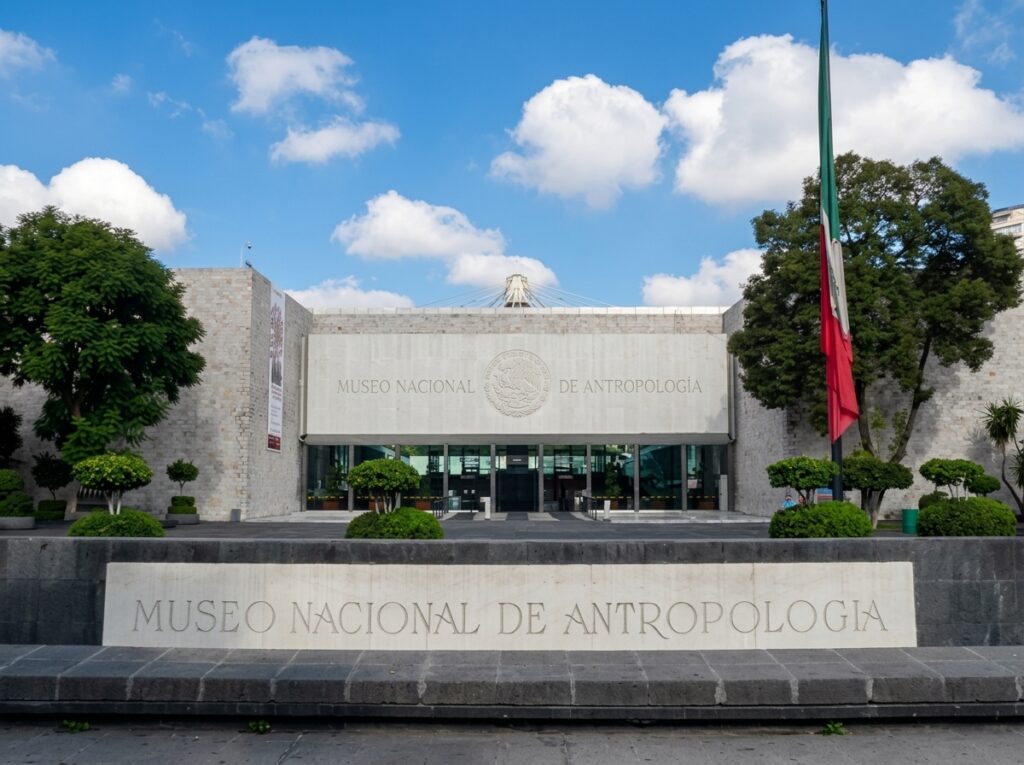
You will start noticing the four letters before your first day in Mexico City is over. They are on the signage at the entrance to the National Museum of Anthropology. They are on the ticket booth at Teotihuacán. They are on the small plaque beside a colonial church in the Centro Histórico, and on the fence around a rectangle of exposed earth where a downtown sidewalk used to be. INAH.
For most visitors the acronym stays decorative — official-looking letters on official-looking signs. It is worth knowing what they stand for, because INAH is the reason the museum you are about to walk through exists in the form it does. It is also, once you understand it, a genuinely useful tool for judging almost anything you are told about Mexico’s past.
The short answer
INAH is the Instituto Nacional de Antropología e Historia — the National Institute of Anthropology and History. It is the federal body responsible for researching, conserving, protecting and presenting Mexico’s archaeological, anthropological and historical heritage. It was created by an organic law published on 3 February 1939, under President Lázaro Cárdenas, and since 2015 it has operated within Mexico’s Ministry of Culture.
What makes INAH unusual is that it is three things at once. It is a research institute, employing more than eight hundred full-time researchers — archaeologists, historians, anthropologists, ethnologists, restorers, epigraphers. It is a museum system, operating a national network that includes the National Museum of Anthropology. And it is a government authority, the legal custodian of every registered archaeological zone in the country, with real regulatory power over what may be excavated, moved, restored, exported or built upon.
There is no single equivalent elsewhere. Imagine the Smithsonian, the National Park Service and a national research council combined into one institution, and you are somewhere close.
A very short history
The story begins more than a century before the institute itself. In 1825, four years after independence, President Guadalupe Victoria founded the Museo Nacional Mexicano — an act of remarkable confidence for a country that barely existed yet, and a declaration that Mexico’s pre-Hispanic past belonged to the new nation rather than to the empire that had just left. The collections gathered under that decision are, by direct descent, the collections you will see in Chapultepec today.
By the 1930s those holdings had grown into something the existing institutions could no longer manage, and Mexico had entered a period of intense national interest in its own indigenous history. The 1939 law created INAH to take custody of all of it.
Three years later, in 1942, the archaeologist Alfonso Caso — the excavator of Tomb 7 at Monte Albán — brought the young school of anthropology into INAH as its teaching arm. It took its present name, the Escuela Nacional de Antropología e Historia, in 1946. And in 1964 the national collections moved into the purpose-built museum in Chapultepec Park where they remain.
That building has since become the institute’s most visible achievement. In December 2022 it was inscribed on UNESCO’s international list of cultural property under Enhanced Protection — the highest level of safeguarding available under international law, and the first site in Latin America and the Caribbean to receive it. We have written about what that designation means for visitors here.
What INAH actually does
Six things, roughly, and each one is visible somewhere on a well-designed visit.
Research. INAH researchers run long-term projects at sites across the country. The interpretive text on a museum label is not a summary of general knowledge; it is the distilled output of that research, often argued over for years before it reaches the wall.
Custody of the archaeological zones. Teotihuacán, Palenque, Monte Albán, Chichén Itzá and the hundreds of less famous sites are INAH-administered. The staff at the gate, the conservation crews, the researchers publishing on the site — all one institution.
The museum network. Dozens of museums nationally, of which the National Museum of Anthropology is the flagship.
Conservation. INAH’s national conservation body, the CNCPC, handles the physical survival of objects — the science of stabilising a jade mosaic or a mural fragment so it lasts another century.
Rescue archaeology. This is the one visitors stumble across by accident. When a construction crew in Mexico City hits something ancient — which happens constantly, because the modern city sits directly on top of the old one — work stops and INAH excavates. Some of the most significant finds of the past fifty years have emerged this way.
Publication. The institute publishes the catalogues, monographs and journals through which specialists argue with one another. This is where the sentence on the museum label came from, several steps upstream.
Sorting out the acronyms
Four sets of initials come up repeatedly in Mexico, and they are not interchangeable.
INAH is the federal institute described above. To be an INAH researcher is to hold a research post at the national institute — a professional appointment, not a course completed.
ENAH is the Escuela Nacional de Antropología e Historia, the specialist school INAH operates. It is where a substantial share of Mexico’s professional archaeologists, historians and anthropologists are trained. A history degree from ENAH is a research degree in the study of Mexico, from the institution that defines the field domestically.
UNAM is the Universidad Nacional Autónoma de México, the country’s largest and most prominent public university, with its own distinguished anthropology and history faculties. Many specialists hold degrees from UNAM and posts at INAH.
SECTUR is the Ministry of Tourism, which administers the federal accreditation for tour guides. This is a real and worthwhile credential covering site knowledge, safety and visitor care — and it is a different kind of credential entirely. It certifies that someone is qualified to lead visitors. It does not, and does not claim to, certify that someone produces original research on what those visitors are looking at.
Why this matters when you are choosing a guide
Search for a museum tour in Mexico City and you will meet the word “expert” several hundred times in an afternoon. It is not a regulated term. It appears in listings written by marketing departments about guides they have never met.
The acronyms are useful precisely because they are not marketing. They are verifiable. A researcher’s institutional affiliation can be checked; a published monograph has an ISBN and a library record; a degree from ENAH or UNAM is a matter of record. When a tour description tells you a guide is INAH-affiliated or ENAH-trained, that is a claim someone could disprove — which is the only kind of claim worth anything.
It also changes what happens on the tour itself. Someone who works inside this system does not simply relay conclusions; they know how the conclusions were reached, which parts remain contested, and which sentence on the museum label a specialist would quietly argue with. That is the difference between being told what an object is and understanding why anyone believes it.
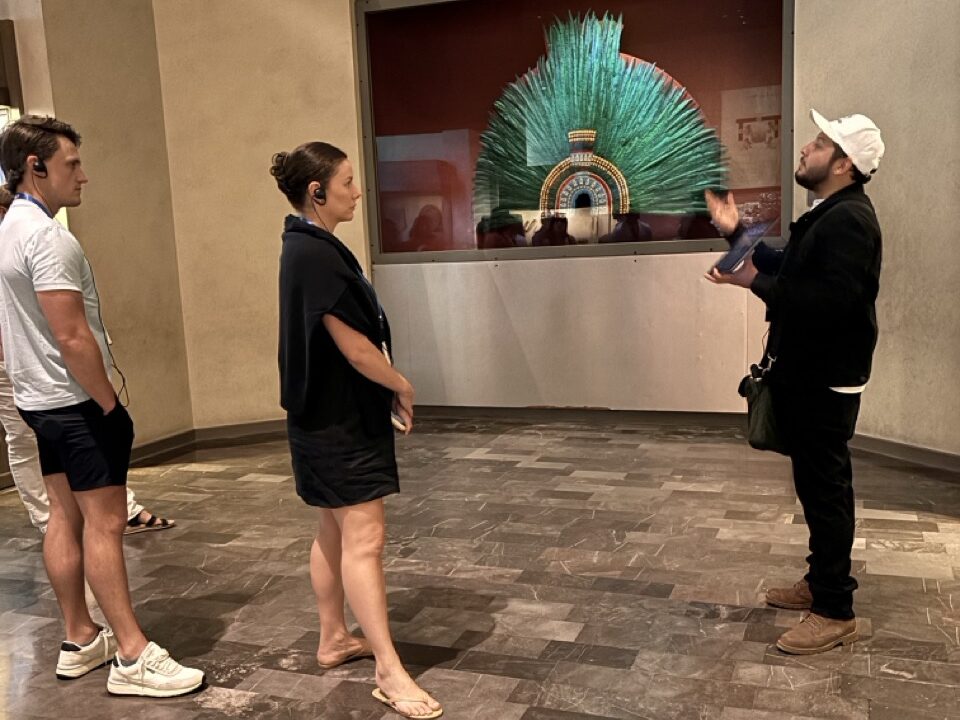
It is the reason Triptlán is built the way it is. Our private tours are designed and led by working historians and researchers — including an INAH epigrapher who reads Maya inscriptions for a living and can do it in front of you, in the gallery, from the stone.
Explore our private tour of the National Museum of Anthropology, booked directly with us, and see the collection with someone who knows where its labels came from.
