
In this Triptlán research note, I present a historical review of how one of the most important pre-Columbian objects displayed in the halls of the National Museum of Mexico, the Tablet of the Cross of Palenque, entered the collections and came to be exhibited. The tablet is made up of three adjoining vertical panels, which entered the museum’s collections at three different moments during the regime of Porfirio Díaz: in 1883, 1908 and 1909.
Palenque is an important Classic Maya archaeological site in the north of the Mexican state of Chiapas. In ancient times it was known as Lakamha’, or “Place of Big Waters,” for its sophisticated hydraulic systems, and it was the seat of an important royal lineage, the Baakal kingdom, led by the famous ruler Pakal in the 7th century.
This relief was carved in the Late Classic period, in AD 692, by order of the ruler K’inich Kaan Bahlam II, eldest son of Pakal. The tablet was part of Kaan Bahlam II’s reconstruction of the Cross Group, the most sacred space in the city, where the local gods lived and were venerated (Figure 1).
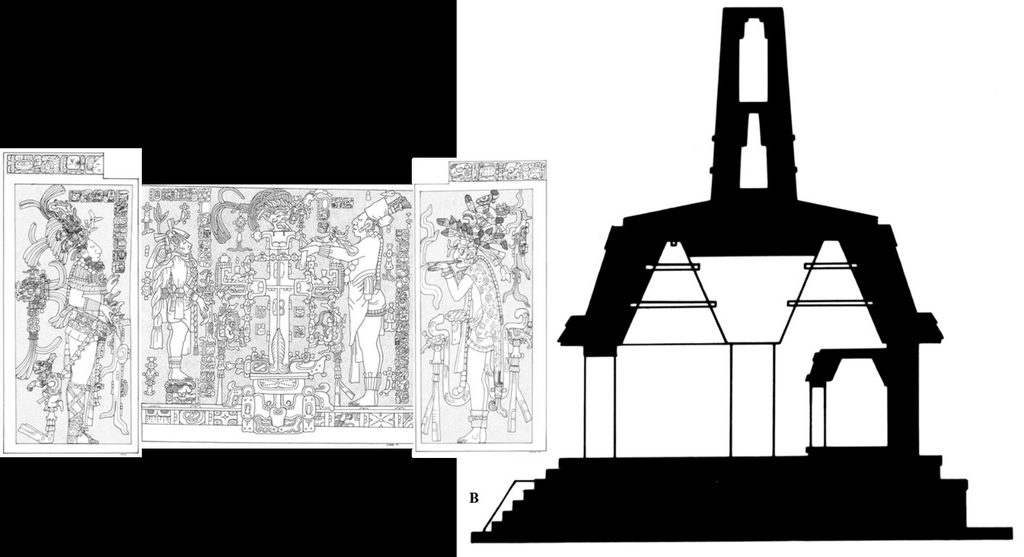
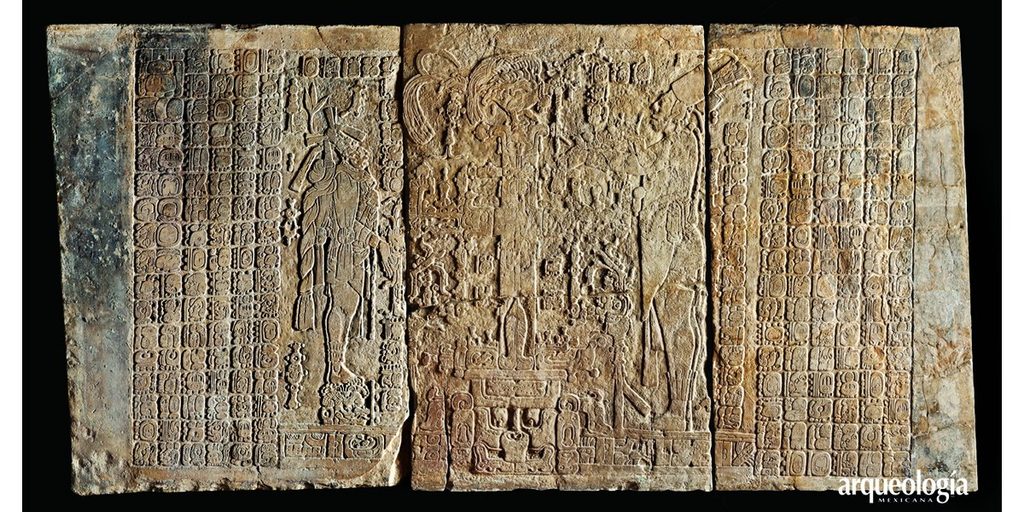
The tablet measures 325 cm wide and 190 cm high. Its iconography centers on a cross-shaped ceiba tree, its trunk covered in jade jewels and beads, on top of which stands the creator god Yax Kokaaj Muut Itzam Naah in the guise of a bird of prey. This world tree is flanked by two portraits of Kaan Bahlam II at two stages of his life (Figure 2). The smaller portrait, on the left, shows him as a six-year-old prince in penitence, wearing the garments of self-sacrifice for his childhood rite of passage. On the other side, he appears as a mature figure acceding to the throne and holding the regalia of kingship. The scene is framed on both sides by long inscriptions recounting mythological narratives and the biographies of the kingdom’s lineage.
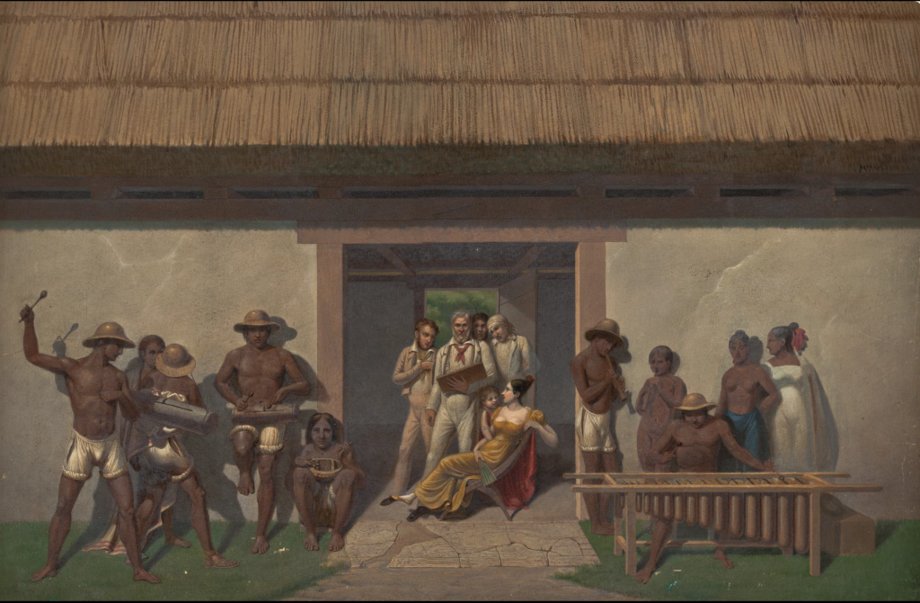
Turning now to the central matter: the Tablet of the Cross was mutilated and looted at two different moments in the 1830s by the Creole elites of the village of Santo Domingo de Palenque, who wanted to reuse its panels as ornaments on the walls and at the entrances of their houses, as can be seen in a lithograph by the French count Frédéric Waldeck (Figure 3).
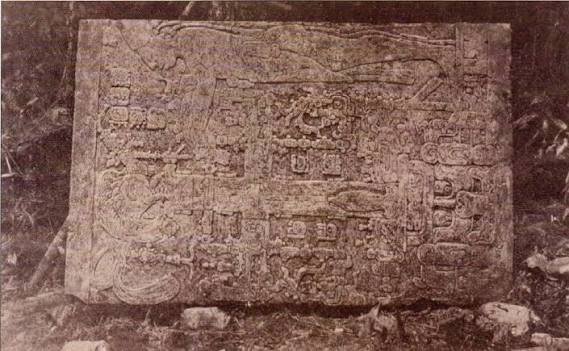
The central panel was detached by an American villager and merchant named Wilhelm Brown, who intended to sell it to the elites of Palenque, who were becoming more interested in the aesthetic and economic value of “antiquities.” Brown never managed to move the monumental fragment to the town of Palenque: local authorities, informed of the looting, stopped him. This is why the central panel was left on the banks of the Otulum River, near the center of the ruins, between 1833 and 1883. For almost fifty years it was recorded there by different explorers, before it was finally moved to the National Museum of Mexico in 1883 (Figures 4 and 5).
The fragments of the right-hand panel were also removed from the inner sanctuary of the Temple of the Cross by Wilhelm Brown, who sent them to New York in 1842 through the American consul Charles Russell. They entered the Smithsonian Institution in Washington in 1858 and remained there until 1908, when the panel was repatriated to Mexico under President Porfirio Díaz, in the run-up to the celebrations of the Centennial of Mexican Independence in 1910. The National Museum of Mexico became a key institution for these celebrations, and its Monoliths Hall was set aside for the exhibition of the Tablet of the Cross.
One fragment was still missing: the left panel, which remained in its original place inside the sanctuary of the Temple of the Cross. To recover it, the Secretary of Public Education, Justo Sierra, commissioned the Mexican archaeologist Leopoldo Batres to move it to the Monoliths Hall in Mexico City. The expedition was well covered by the Mexican press, with some extraordinary photographs of the removal and transport (Figure 6). It was also filmed by Gustavo Silva and photographed by Guillermo Kahlo, father of the painter Frida Kahlo. Silva’s film, a 3,000-foot reel, is the earliest film of any Mexican archaeological site.
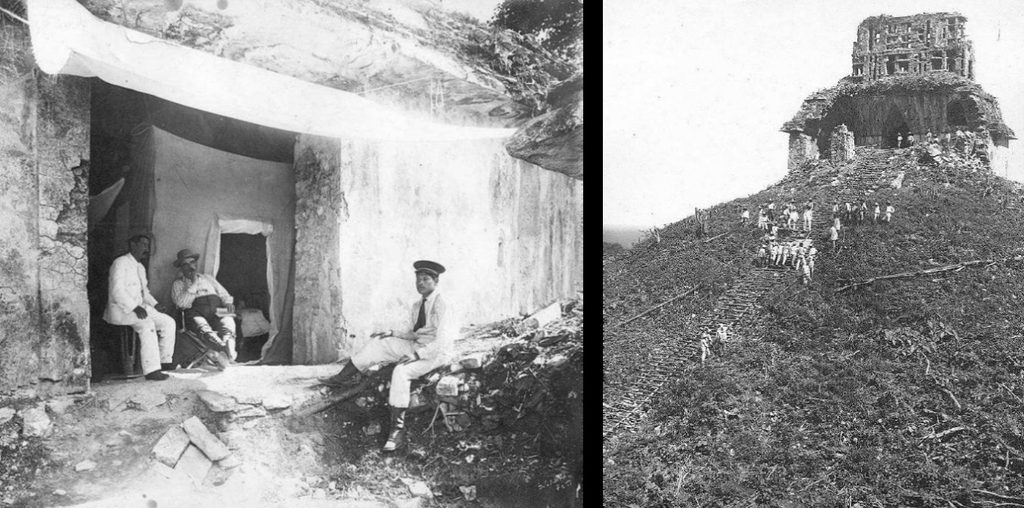
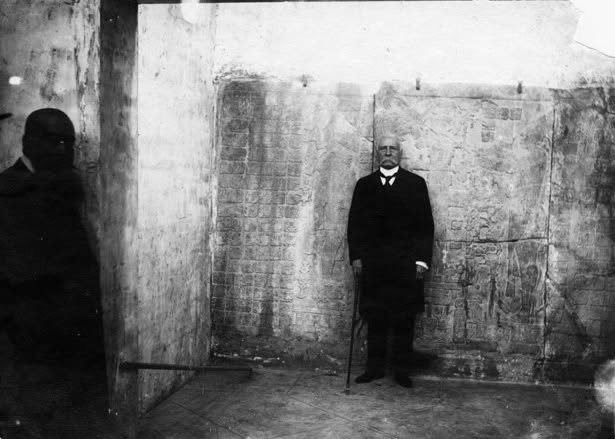
With the arrival of the left panel at the National Museum, and its proper restoration, the Monoliths Hall displayed this important monument as part of a narrative that extolled the grandeur of the pre-Columbian past to prop up the political apparatus of the Porfiriato, a regime on the edge of collapse. Curiously, one of the last photographs of Porfirio Díaz as president of Mexico (Figure 7), still projecting the image of a strong and fierce politician, was taken with the Tablet of the Cross in the background, during the commemorations of the Centennial of Mexican Independence, shortly before the Mexican Revolution broke out and spread across the country. But that is another episode in the history of the National Museum of Mexico and its archaeological collections, for an upcoming Triptlán research note.
About the author
Ángel A. Sánchez Gamboa is a historian and epigrapher at Mexico’s Instituto Nacional de Antropología e Historia (INAH), where he works with the CNCPC, INAH’s national coordination for the conservation of cultural heritage. Since 2015 he has been the epigrapher on an INAH project studying the archaeological collections in museums across Chiapas. He is co-author, with Martha Cuevas García and Yuriy Polyukhovych, of Monumentos escultóricos de Palenque, the catalog of Palenque’s sculptural corpus, and has published research on Toniná, Palenque and Chinkultic. He holds a History degree from UNAM and leads Triptlán’s Maya epigraphy tour at the National Museum of Anthropology.
