
Before explaining the iconography and hieroglyphic inscriptions of the sarcophagus of Pakal, it is crucial to dispel one myth: was Pakal an interplanetary astronaut? No. This is a huge misunderstanding that spread widely with the boom in science fiction and New Age literature in 1968–1969, in particular after the publication of Chariots of the Gods? by Erich von Däniken, one year before Apollo 11 landed on the Moon in 1969.
By accepting these UFO theories, we fail to recognize the cultural achievements of pre-Columbian societies on their own terms: their social and political organization, urban planning, hieroglyphic writing and calendar systems, artistic traditions and pantheons of gods, among other features we might equate with other great ancient civilizations such as the Sumerians, Egyptians, Phoenicians or Greeks.
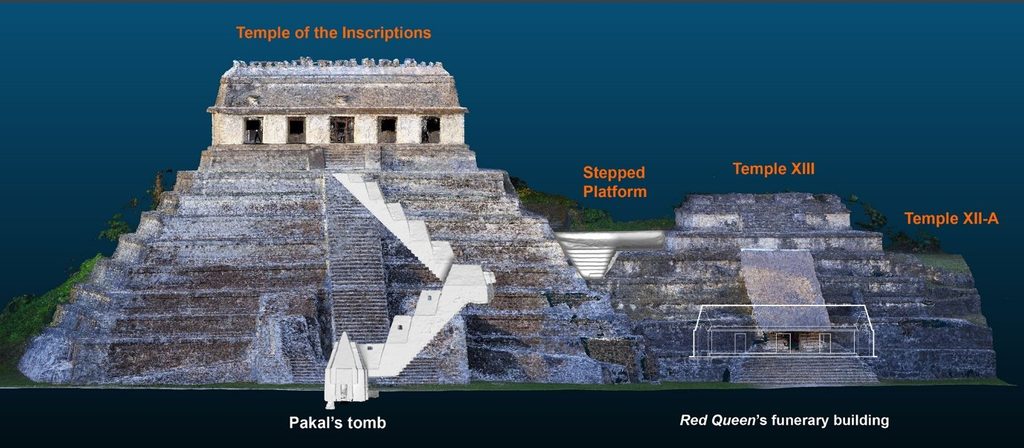
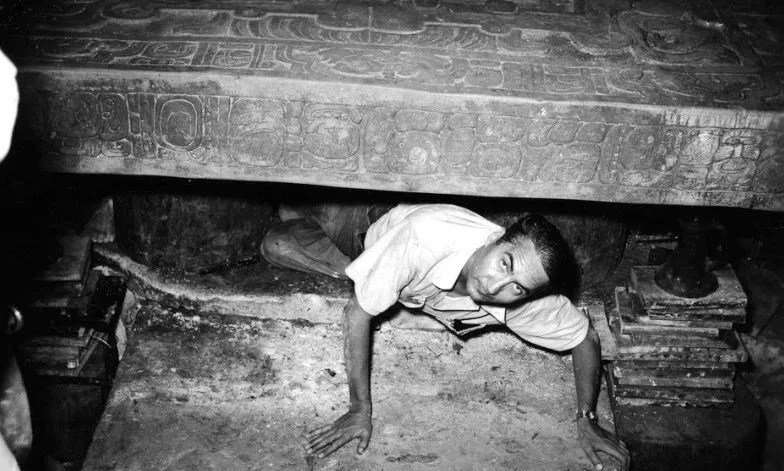
Pakal’s tomb, buried inside the Temple of the Inscriptions, was discovered by the French-Mexican archaeologist Alberto Ruz Lhuillier on June 15, 1952 (Figures 1 and 2). We can begin by asking: who was K’inich Janahb Pakal, and why did he become the most popular Maya ruler? Pakal was a long-lived ruler (he reigned from AD 615 to 683) who established Palenque as a dominant royal court on the western edge of the Maya area, guiding the city into its golden age after a period of political crisis, warfare and invasions by its enemies, above all the most powerful Maya city of the time, the Snake kingdom (first based at Dzibanche and later at Calakmul, in the south of the Yucatán Peninsula).
Pakal’s greatest urban project was the renovation of the Palace in AD 652–668: the city’s largest architectural complex and the political, administrative and ceremonial heart of Lakamha’, the ancient name of Palenque. He also took revenge, leading major military campaigns against the allies of the Snake kingdom who, decades earlier, had taken part in the two invasions of Lakamha’, in AD 599 and AD 611.
If Pakal was not the most powerful Maya king, as Yuknoom Ch’een II of Calakmul or Jasaw Chan K’awiil II of Tikal were, why has he become so popular over the past seven decades? Because he commissioned one of the most extraordinary funerary temples ever built in the pre-Columbian era (Figure 1). No other Maya or Mesoamerican dignitary undertook such an ambitious project.
One might also ask whether Pakal’s funerary project was prompted by the deaths of his wife, Ix Tz’akbu Ajaw (also known as the “Red Queen”), in AD 673, and of his younger son, Tiwool Chan Mat, in AD 680. These events naturally had a deep impact on Pakal (the funerals and temples dedicated to them, the mourning and the posthumous ceremonies) and inspired him to plan a funerary program unlike any seen before, one that would endure for eternity. Pakal sought to transcend his own death and achieve a kind of spiritual immortality, as an ancestral figure who would go on nourishing his successors and his entire community.
We might think of Pakal as our American Gilgamesh, allowing for cultural differences and using analogies with caution: the Sumerian king of Uruk and hero of The Epic of Gilgamesh, who failed to win eternal physical life but achieved immortality through his legacy and his city’s walls. As we will see, Pakal did the very same.
The central theme of the relief on the sarcophagus lid is Pakal’s rebirth after death and his deification as an ancestor. He adopts the gesture of the youngest of Palenque’s patron gods, Unen K’awiil, or “Baby K’awiil,” shown in his characteristic birth pose (Figures 3 and 4). The shape of his head and his haircut allude to the young Maize God, as does his netted skirt with jade beads, while a flame or torch sprouts from his forehead, an attribute of the god K’awiil, god of lightning, power and royal lineage.
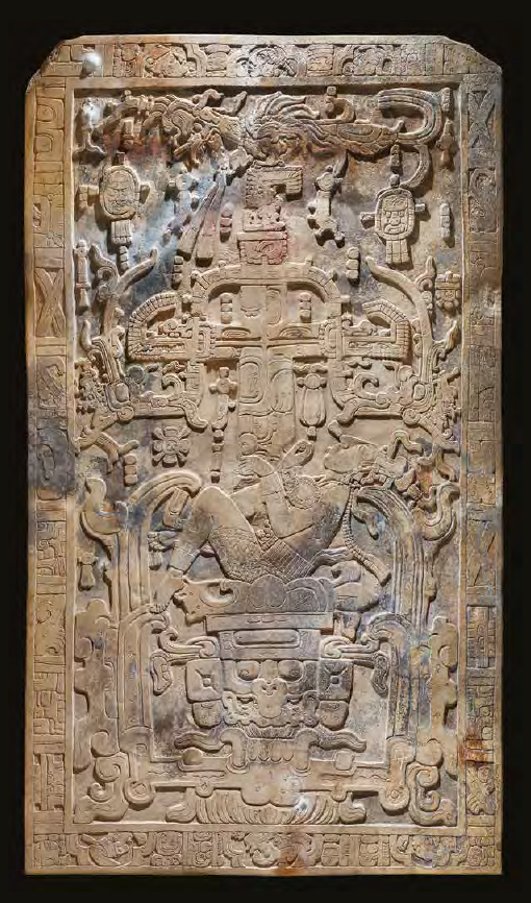
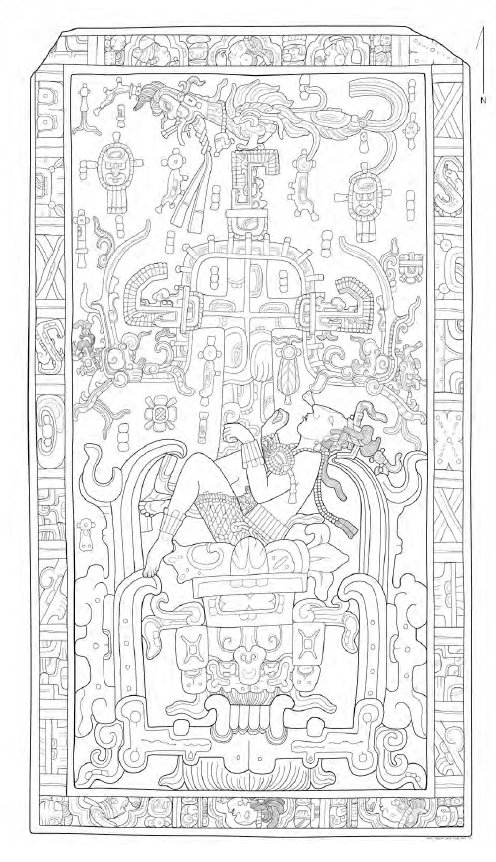
Pakal is reborn through the jaws of the earth monster, emerging from the underworld in his apotheosis as an ancestor. Behind him rises the world tree, a cross-shaped ceiba adorned with jade jewels and beads, a shining tree that connects the levels of the Maya cosmos. On top of the ceiba stands the creator god Itzam Naah in his bird form, the supreme god witnessing Pakal’s death and rebirth. On both sides, the scene is framed by a celestial band of the sun, the moon and other stars and cosmic signs, and at the top and bottom of the band appear the courtiers and nobles who served Pakal during his lifetime and witnessed his death and rebirth.
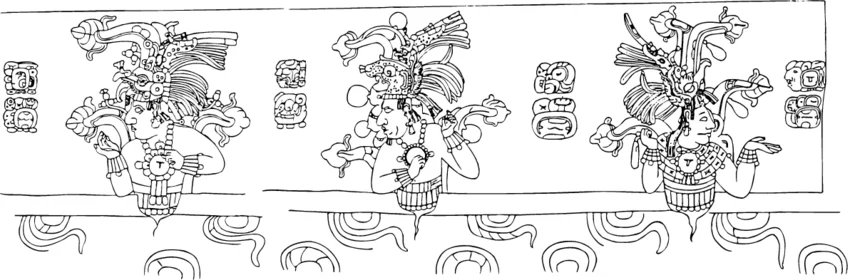
Finally, the sides of the sarcophagus depict several of the rulers who preceded Pakal, including the only queen of Palenque, Ix Yohl Ik’nal, as well as his grandfather and his parents. All appear as ancestral figures in the form of fruit trees (avocado, sapote, nance, guava and guaje) sprouting from the earth (Figure 5). Together, these figures form a kind of supernatural orchard. Pakal is in the process of becoming a new fruit tree, joining this ancestral orchard that will nourish his successors and the kingdom itself for eternity.
About the author
Ángel A. Sánchez Gamboa is a historian and epigrapher at Mexico’s Instituto Nacional de Antropología e Historia (INAH), where he works with the CNCPC, INAH’s national coordination for the conservation of cultural heritage. Since 2015 he has been the epigrapher on an INAH project studying the archaeological collections in museums across Chiapas. He is co-author, with Martha Cuevas García and Yuriy Polyukhovych, of Monumentos escultóricos de Palenque, the catalog of Palenque’s sculptural corpus, and has published research on Toniná, Palenque and Chinkultic. He holds a History degree from UNAM and leads Triptlán’s Maya epigraphy tour at the National Museum of Anthropology.
