
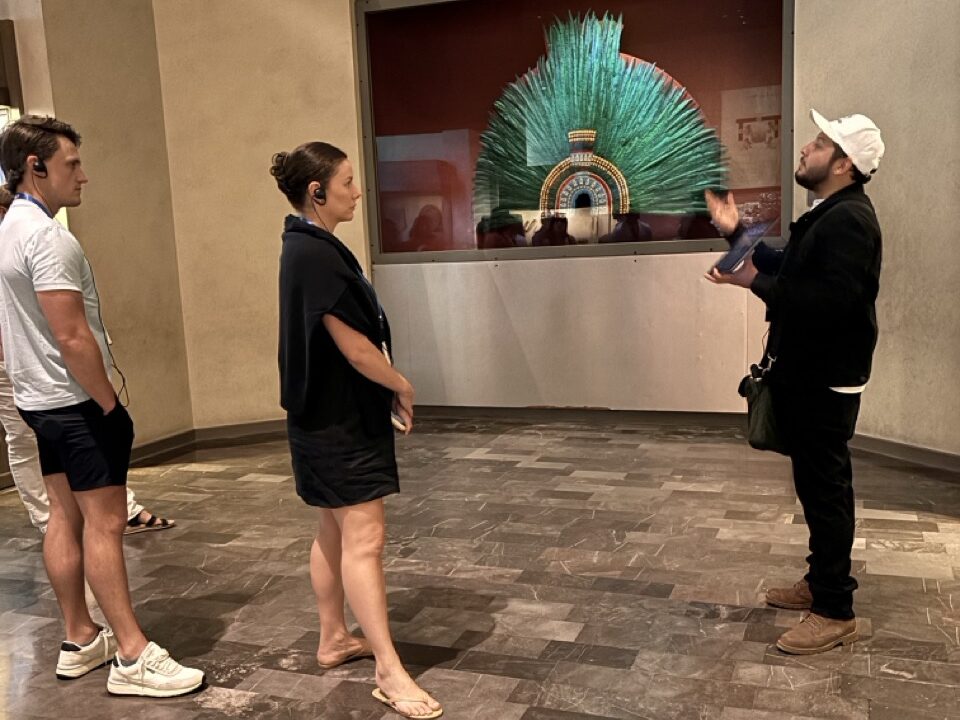
We run private tours of this museum, so you should read what follows with that in mind. It is also the reason we are going to start with the case against.
When you genuinely do not need a guide
There are visitors who should walk in alone, and we would rather say so than pretend otherwise.
If you already know this material — if you have read about Mesoamerica for years, if the difference between Zapotec and Mixtec is not a new distinction to you, if you are the kind of museum-goer who reads every label and resents being moved along — then a tour may take away more than it gives you. The National Museum of Anthropology rewards slow, self-directed looking better than almost any museum on earth. Its labels are unusually good, because they are written from the research of the institute that runs the place rather than from a general-interest summary.
If you have a full unhurried day, no fixed schedule, and a genuine appetite for wandering, you will do fine alone. And if the museum is one stop on a long trip and you want ninety minutes with the famous objects before moving on, a guide is more structure than the visit needs.
That is not a small set of people. If you recognise yourself in it, go — the admission is modest and the collection is extraordinary. Our practical guide to planning a visit has the hours, tickets and timing advice you will want, and it is free.
What the numbers do to everyone else
Here is the problem the museum presents to a first-time visitor with a normal amount of time.
Twenty-two permanent halls. A collection numbering in the hundreds of thousands of objects. Roughly forty-five thousand square metres of building. And in 2025, more than five million visitors came through it — a figure that rose sharply on the year before, and which you will feel on a Sunday afternoon in the Mexica hall.
Nobody sees this museum. People see a fraction of it and then get tired, which is a different experience. What happens to most unguided visitors is predictable and slightly sad: two absorbing hours in the first halls, a growing sense that time is running out, a forced march past the remaining rooms, and a final twenty minutes spent looking for the exit. They leave having photographed the Sun Stone and understood roughly none of it.
The scarce resource is not money. It is attention, and there is far more museum here than any visitor has attention for. Every decision about what to skip is a decision about what your day was worth — and those decisions are much easier to make with prior knowledge than without it.
What labels can do, and what they cannot
A museum label has perhaps sixty words to work with and a duty to be uncontroversial. It can tell you what an object is, roughly when it was made, and where it came from. That is identification, and this museum does it well.
What a label cannot do is argue. It cannot tell you that specialists have disagreed for fifty years about whose face occupies the centre of the Sun Stone, or that the famous plants carved on one celebrated sculpture were identified by a hypothesis that remains contested, or that the great feathered headdress in the Mexica hall is a reproduction and the original has been in Vienna for centuries under conditions that make its return physically impossible. It cannot tell you which sentence on the wall beside it a researcher would quietly qualify.
That is the actual content of this museum — not the objects alone, but the century of argument about what they mean. It is not on the walls, and no audio guide will give it to you, because audio guides are recorded once and must be safe.
This is also, bluntly, where guided tours divide into two categories. A guide who has memorised the label content will give you the labels, out loud, while you walk. That is worth something — mostly routing and company — but it is not worth a great deal, and if that is the tour you are being offered, going alone is genuinely the better choice.
What changes with a historian
Four things, in our experience.
The route is already decided. Someone who knows the building has made the hard cuts before you arrive — which halls at which hour, which rooms fill first, what to see while the crowds are elsewhere. You spend your attention on objects rather than on navigation.
Objects become arguments. A specialist does not simply tell you what something is. They tell you how anyone knows, what the competing readings are, and what changed when a particular discovery was made. Once you have heard this done to three objects, you start doing it yourself to the fourth — which is the point, and the part that lasts.
You can ask anything. On a private tour the whole thing bends toward what interests you. If the Maya hall grips you and the ethnography upstairs does not, the day reshapes itself. That is not possible in a group of thirty, and it is not possible alone, because alone there is nobody to answer.
You are not told anything untrue. This sounds like a low bar. It is not. The tour listings sold around this city are full of errors, some of them substantial — the persistent description of Teotihuacán as a Maya site being the most notorious. When your guide is a working researcher, that category of problem simply does not arise.
If you do book, which tour?
Two different visits, for two different people.
The full museum, with a historian. The right choice for a first visit, and for most visitors generally. You get the sweep of Mesoamerica — Teotihuacán, the Mexica, Oaxaca, the Maya — as a single connected story rather than a series of rooms, at a private pace, with the arguments included. This is our core private museum tour.
The Maya hall, with an epigrapher. A more specialised proposition, and for the right person the best hour in the building. Maya writing is the only fully deciphered script of the ancient Americas, which means the inscriptions in that hall are readable documents rather than decoration — dates, names, accessions, wars. On this tour, an INAH epigrapher reads them to you from the stone. If you have ever wanted to watch someone do that, this is where it happens.
How to decide
One question, honestly answered: do you want to have seen this museum, or to have understood it?
Both are legitimate. Seeing it is a fine way to spend a morning, and you can do that on your own with a good plan and comfortable shoes. But if this is your one trip to Mexico City in a decade, and the collection is part of why you came, then the difference between those two verbs is the whole question — and it is not answered by the ticket price. It is answered by who is standing beside you.
See our private museum tours and book directly with us. Small, private, led by working historians, and paced entirely around you.
