
Ángel A. Sánchez Gamboa (Historian and epigrapher of the National Institute of Anthropology and History)
This research is part of a series of informative notes that Triptlan will publish periodically regarding the origins of the Maya Hall at the National Museum of Anthropology, which goes back to the Late 18th century. The conformation of a new class of Creole intellectuals in the territory of the New Spain and beyond (most of them were embracing the Enlightenment as a its main political and ideological flag), had immediate effects in the practices of collecting and protecting antiquities –in instance, during the 16th–17th centuries, antiquities were considered “idols” and censored by Inquisition authorities, hence, they were destroyed, burned, and/or mutilated. Antiquities began to matter, this attitude is manifest with Viceroy Antonio María Bucareli y Ursúa (in office between 1771–1779), who ordered to gather and protect antiquities in the Royal University (Real y Pontificia Universidad de México).
Spanish kings, Charles III (1759–1788) and IV (1788 – 1808), sponsored the exploration and collection of New Spain’s antiquities. In this sense, explorations to the Maya area were commissioned by these two Spaniard kings, specially to the ruins of Palenque (Figure 1; top figure) –considered the “crown jewel” of New World, for European and American intellectuals, for some of them, even equal to Greek and Egyptian art. In the 1780’s, Jose Antonio Alzate y Ramírez visited the ruins of Xochicalco –in the current state of Morelos (Figure 1; bottom figure)– producing one of the first studies and graphic documentations of pre-Hispanic ruins and its monuments.
Few years later, in 1790-1791, inhabitants of the New Spain were amused with the discovery of three monoliths unearthed during the urban renovations of the New Spain’s central plaza, led by Viceroy Revillagigedo: these sculptures correspond to the famous Calendar Stone, the Stone of Tizoc, and the Coatlicue. A new sensitiveness and awareness of the New Spain elites is evident after they incorporated these monoliths into the very heart of the urban landscape of the capital, as some kind of open-air museum if it’s worth the analogy.
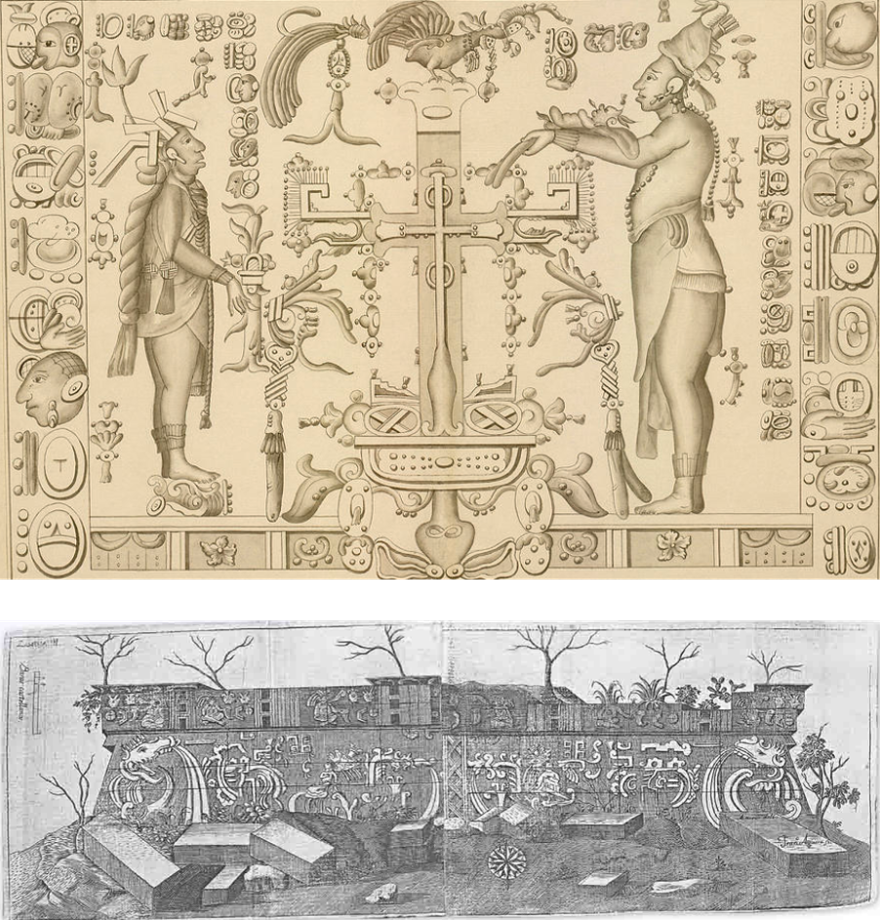
Figure 1. Late 18th century drawings of the New World ruins and antiquities. Upper figure is a drawing of the Tablet of the Temple of the Cross by Ricardo Almendáriz during the Royal Expedition of Captain Antonio del Río in 1787; bottom figure is the drawing of the Temple of the Feathered Serpent of Xochicalco by José Antonio Alzate.
To address the matter at hand in this Triptlán note, the first Mayan antiquities brought to the capital of the New Spain occurred during the reign of the king Charles IV, as result of the last expedition bv Guillermo Dupaix, a retired captain of the Royal Regiment of Dragoons –we might call him the pioneer of what later would be known as Mexican archaeology. In the company of his everlasting draftsman Luciano Castañeda, Dupaix gathered some monuments from the ruins of Palenque and Tonina in the current state of Chiapas.
Within the effects of Hispanic revolutions in the New World during the Early 19th century, the Mexican Independence of 1821 opened a new political culture in which the creation of a national museum was necessary for the constitution of the new Mexican state –of course not free from political struggles between conservative and liberal wings that affected directly the decisions undertaken in relation with the protection and exhibition of Mexican antiquities. Thus, the National Museum of Mexico was officially created in 1825 by order of President Guadalupe Victoria.
From its origins, the National Museum incorporated a couple of Mayan sculptures, those already mentioned from Palenque and Tonina that were assembled by Guillermo Dupaix in 1808 –after Dupaix’s death, his draftsman Castañeda, in 1825, donated these sculptures to the first conservator of the National Museum, Isidro Icaza. Another collection of Mayan antiquities was gathered between 1824 and 1827 by Generals Javier Bustamante and Juan Pablo Anaya as part of the federal mission they led to Chiapas during the annexation of this territory to Mexico –it is important to state that in Colonial times, the current state of Chiapas was part of the Audience of Guatemala and not of the New Spain.
Two sculptures of Tonina, one gathered by Dupaix and the other by Anaya, were drawn in 1830 (Figures 2 and 3) –using the graffito technique or crayón du conté– by the Rhenish artist Maximilien Franck during his visit to the National Museum; Franck was recommended to the conservator Isidro Icaza by the American ambassador Joel R. Poinsett.
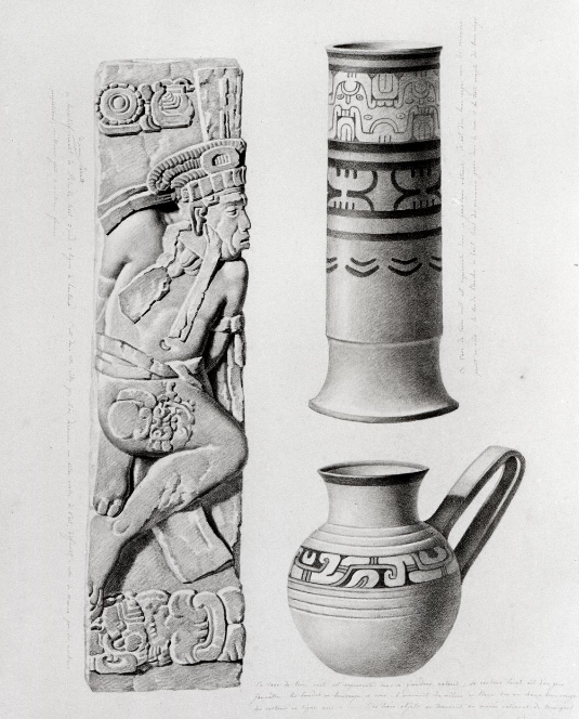
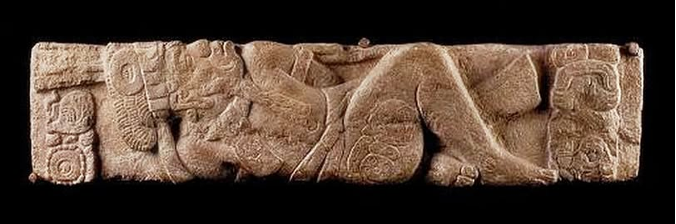
Figure 2. A hieroglyphic stairway fragment from Tonina with a tied-up captive, known as Monument 27. Upper figure is the drawing made by Maximilien Franck in 1830 © The British Museum; the bottom figure is a modern photograph of its actual conservation conditions in the Maya Hall © Archivo Digital MNA
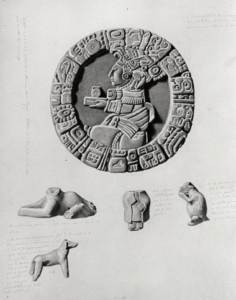
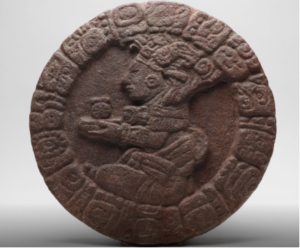
Figure 3. A circular altar (Altar 1) from Tonina gathered by Juan Pablo Anaya in the 1820s. Left figure is the drawing made by Maximilien Franck in 1830; right side is a moder photograph of its current conditions in the Maya Hall © Archivo Digital MNA.
Another set of Mayan antiquities were included in the book Historia Antigua de México y su conquista, published in 1846 (Figure 4) by the American historian William Prescott with the participation of the current director of the National Museum, Isidro Gondra, incorporating some illustrations of the most important objects of the museum. In this volume they included four clay figurines or whistles from the Peninsula of Yucatan area –known as “nacas” during the 19th century.
The next years were of political strife between conservative and liberal wings, including the North American invasion (1846–1848) and the imposition of the Austrian archduke Ferdinand Maximilian from the House of Habsburg-Lorraine as Emperor of Mexico in 1864 with the Second Mexican Empire. Leaving aside the instability and current state of political crisis, Emperor Maximilian was a key figure in the transmutation process of the National Museum. In 1865-1866, he relocated the National Museum from the Royal University to the Casa de Moneda, located beside the National Palace and He renamed it as Public Museum of Natural History, Archaeology, and History (“Museo Público de Historia Natural, Arqueología e Historia”).
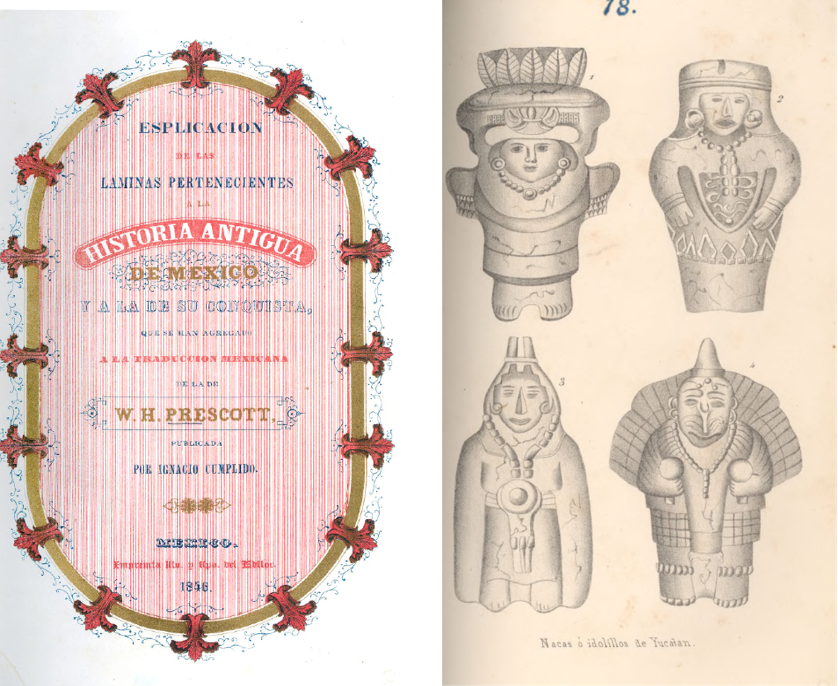
Figure 4. William Prescott’s book with four figurines or whistles from the Yucatan area.
In this vein, Léon-Eugène Méhédin –a French architect, archaeologist, and photographer who was part of the Scientific Commission of Mexico during the Second Mexican Empire– took in 1865 one of the first known photographs (Figure 5) of the sculptural collections of the museum, including the Hieroglyphic Stairway fragment from Tonina (currently known as Monument 27) drawn by Maximilien Franck thirty-five years before.
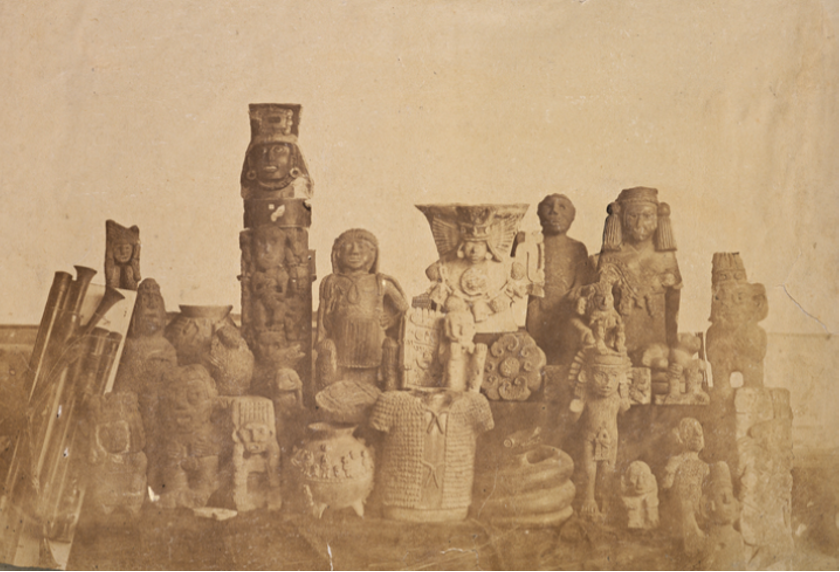
Figure 5. Léon-Eugène Méhédin’s photograph of some antiquities including Monument 27 from Tonina in lower-right side of the photograph. (Published in Arqueología Mexicana, 102)
The relocation of all the collections (archaeological, botanical, among others) to the Casa de Moneda was stopped by different social and political reasons, including the execution of Maximiliano in 1867 and the changing political regime to what is called “The Restored Republic”; it was until 1873, this is, one year after the death of president Juárez and during the period of President Sebastian Lerdo de Tejada, when the relocation of the major sculptures was finished.
The new setting of these monoliths was captured in the stereoscopic views taken by the American photographer Benjamin Kilburn in the patio of the Casa de Moneda, i.e., the Coatlicue and the Chac Mol of Tlaxcala scattered, among other monoliths, in the patio of the new location of the National Museum (Figure 6).
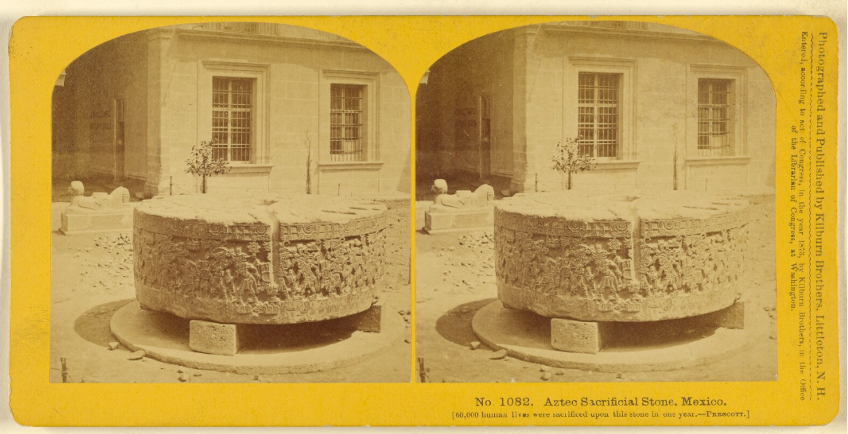
Figure 6. Benjami Kilburn’s stereoscopic views were taken in 1873 in the patio of the National Museum now in its new setting in the Casa de Moneda. © Getty Images
In 1877, Yucatan’s governor ordered the confiscation from the French explorer August Le Plongeon of the Chac Mool (Figure 7), a sculpture he had recently discovered at Chichen Itza; the piece was added to the museum’s collections in May of that same year. It was photographed by distinguished travelers and, even today, is one of the most emblematic archaeological pieces still exhibited in the last section of the Maya Hall of the National Museum of Anthropology.
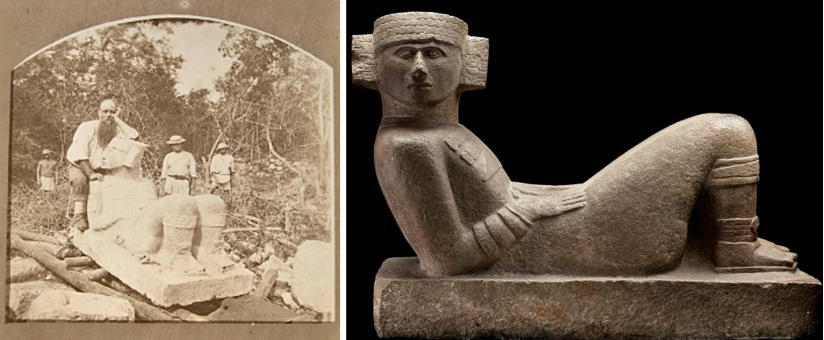
Figure 7. The sculpture of Chac Mol was discovered by August Le Plongeon in Chichen Itza. Left image is a photograph of the transportation of the monument before its seizing in 1877 © Collection Manuel Álvarez Bravo; right image is a photograph of the monument in the Maya Hall. © Archivo Digital MNA
Le Plongeon’s seizure of the Chac Mol occurred in the eve of the Porfiriato which introduced major cultural politics related with the protection of antiquities; this will be very important in the dawn of a newborn Mexican nationalism, the pre-Hispanic past was interwoven with a new epoque of political, social, and cultural progress, but this is another history of the National Museum in which we are going detail in our next upcoming research note.
Don’t miss it, Triptlaners!
Suggested lectures:
Claudia Guerrero Crespo, María Hernández Ramírez, Ignacio Rodríguez García y Octavio Martínez Acuña,
2022 El Museo Nacional de 1825 a 1876: Organigrama histórico, México, Secretaría de Cultura, Instituto Nacional de Antropología e Historia, Chapa Ediciones.
Jane M. Walsh,
2010 “Retrato de una colección. El Museo Nacional en 1865”, Arqueología Mexicana 17(102), pp. 78-83.
2004 “Natural History, National Museum and Anthropology in Mexico”, in Perspectivas Latinoamericanas, 1, pp. 94-106.
Miruna Achim,
2021 ídolos y antigüedades: la formación del Museo Nacional de México, México, Secretaría de Cultura, Instituto Nacional de Antropología e Historia.
About the author
Ángel A. Sánchez Gamboa is a historian and epigrapher at Mexico’s Instituto Nacional de Antropología e Historia (INAH), where he works with the CNCPC, INAH’s national coordination for the conservation of cultural heritage. Since 2015 he has been the epigrapher on an INAH project studying the archaeological collections in museums across Chiapas. He is co-author, with Martha Cuevas García and Yuriy Polyukhovych, of Monumentos escultóricos de Palenque, the catalog of Palenque’s sculptural corpus, and has published research on Toniná, Palenque and Chinkultic. He holds a History degree from UNAM and leads Triptlán’s Maya epigraphy tour at the National Museum of Anthropology.
